
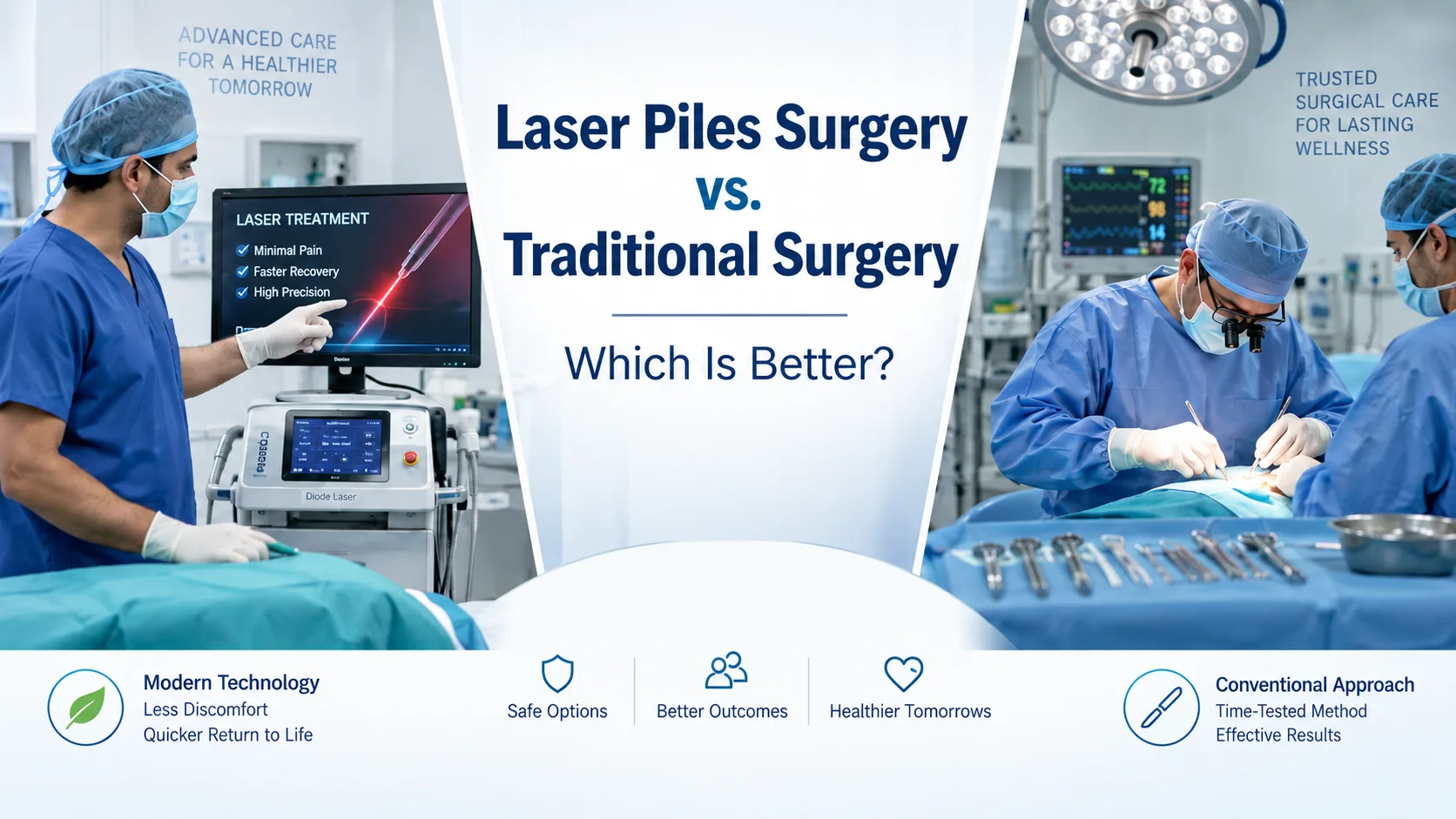
If you are considering piles treatment and surgery, you may wonder whether laser piles surgery is better than traditional hemorrhoid surgery. The right choice depends on the grade of piles, whether they are internal or external, your symptoms, and your recovery expectations.
Laser hemorrhoidoplasty can offer less early postoperative pain, reduced bleeding, and a faster return to normal activities in selected patients. Traditional excisional hemorrhoidectomy, however, remains an important option for larger external hemorrhoids and advanced combined piles.
What Is Laser Piles Surgery?
“Laser piles surgery” commonly refers to laser hemorrhoidoplasty (LHP). During the procedure, laser energy is delivered to the hemorrhoidal tissue to shrink it and reduce its blood supply.
Unlike conventional hemorrhoidectomy, large areas of tissue are generally not surgically removed.
Patients who want to understand the procedure in more detail can also read about laser surgery for piles and different types of piles treatment.
Research comparing laser hemorrhoidoplasty with conventional hemorrhoidectomy has reported lower early postoperative pain, less blood loss, shorter operating time, and quicker return to routine activities in suitable patients.
However, laser treatment is not automatically the right choice for every type or grade of piles.
What Is Traditional Piles Surgery?
Traditional piles surgery generally refers to excisional hemorrhoidectomy, including procedures such as Milligan-Morgan or Ferguson hemorrhoidectomy.
During traditional surgery, enlarged hemorrhoidal tissue is surgically removed. Because tissue is excised, recovery can involve more postoperative discomfort compared with less invasive techniques.
Traditional hemorrhoidectomy may still be preferred in patients with large external piles, significant prolapse, or advanced combined internal and external hemorrhoids.
Laser Piles Surgery vs Traditional Surgery
| Factor | Laser Hemorrhoidoplasty | Traditional Hemorrhoidectomy |
| Early postoperative pain | Usually lower | Usually higher |
| Bleeding | Generally less | May be comparatively more |
| Return to routine | Often faster | Usually takes longer |
| Tissue removal | Shrinks hemorrhoidal tissue | Removes hemorrhoidal tissue |
| Suitable cases | Selected Grade II–III internal piles | Large external or advanced Grade III–IV piles |
| Recurrence | Possible | Possible |
The comparison should not be based only on which technique sounds more advanced. The severity and type of piles are more important when selecting treatment.
Which Treatment Should You Choose?
A simple four-step approach can help you understand the decision.
1. Identify the Grade of Piles
Piles are commonly classified from Grade I to Grade IV depending on prolapse and severity.
Mild cases may respond to dietary changes, medicines, or office-based procedures, while advanced disease may require surgical treatment.
2. Understand Your Symptoms
Bleeding, pain, itching, swelling, prolapse, and difficulty during bowel movements can occur with piles.
Some symptoms may need earlier medical evaluation. Read about the symptoms of piles you should never ignore if you are experiencing persistent or recurring problems.
3. Consider Your Recovery Requirements
For working professionals and patients who want to resume routine activities sooner, recovery time can influence the treatment discussion.
Laser hemorrhoidoplasty may provide a shorter early recovery period for suitable patients. Traditional surgery may require more recovery time, particularly when larger amounts of tissue are removed.
4. Discuss Long-Term Results
Ask your surgeon about recurrence, postoperative pain, wound care, possible complications, recovery time, and whether the procedure is suitable for your specific hemorrhoid grade.
Real-World Examples
Example 1:
A working professional with persistent Grade II or selected Grade III internal hemorrhoids despite dietary and lifestyle changes may be assessed for minimally invasive treatment options such as laser hemorrhoidoplasty.
Example 2:
A patient with large external piles and significant Grade IV prolapse may require excisional hemorrhoidectomy if the affected tissue needs to be removed.
These are general examples. A physical examination is necessary before deciding on treatment.
Can Piles Be Treated Without Surgery?
Yes. Not every patient with piles requires surgery.
Increasing dietary fibre, drinking adequate water, avoiding excessive straining, and reducing prolonged toilet sitting can help manage mild hemorrhoids.
Some patients may also benefit from office-based treatments such as rubber band ligation. Surgery is generally considered when symptoms remain persistent, piles are advanced, or conservative treatments are unsuccessful.
How Long Does Recovery Take After Pile Surgery?
Recovery depends on the procedure performed, hemorrhoid severity, individual healing, bowel habits, and postoperative care.
Laser procedures may allow some suitable patients to return to daily activities sooner, while recovery after traditional hemorrhoidectomy can take longer.
For a detailed explanation, read how long piles surgery recovery takes.
Conclusion
Laser piles surgery may offer less early pain, reduced bleeding, and quicker recovery in selected patients, while traditional hemorrhoidectomy remains an important treatment for larger external or advanced piles.
The best treatment should therefore not be selected only because one procedure uses a laser.
Your piles grade, symptoms, internal or external involvement, previous treatment, and overall health should all be evaluated before surgery.
If you are experiencing repeated bleeding, pain, prolapse, swelling, or discomfort, consult an experienced surgeon for proper diagnosis and a personalised treatment plan.