
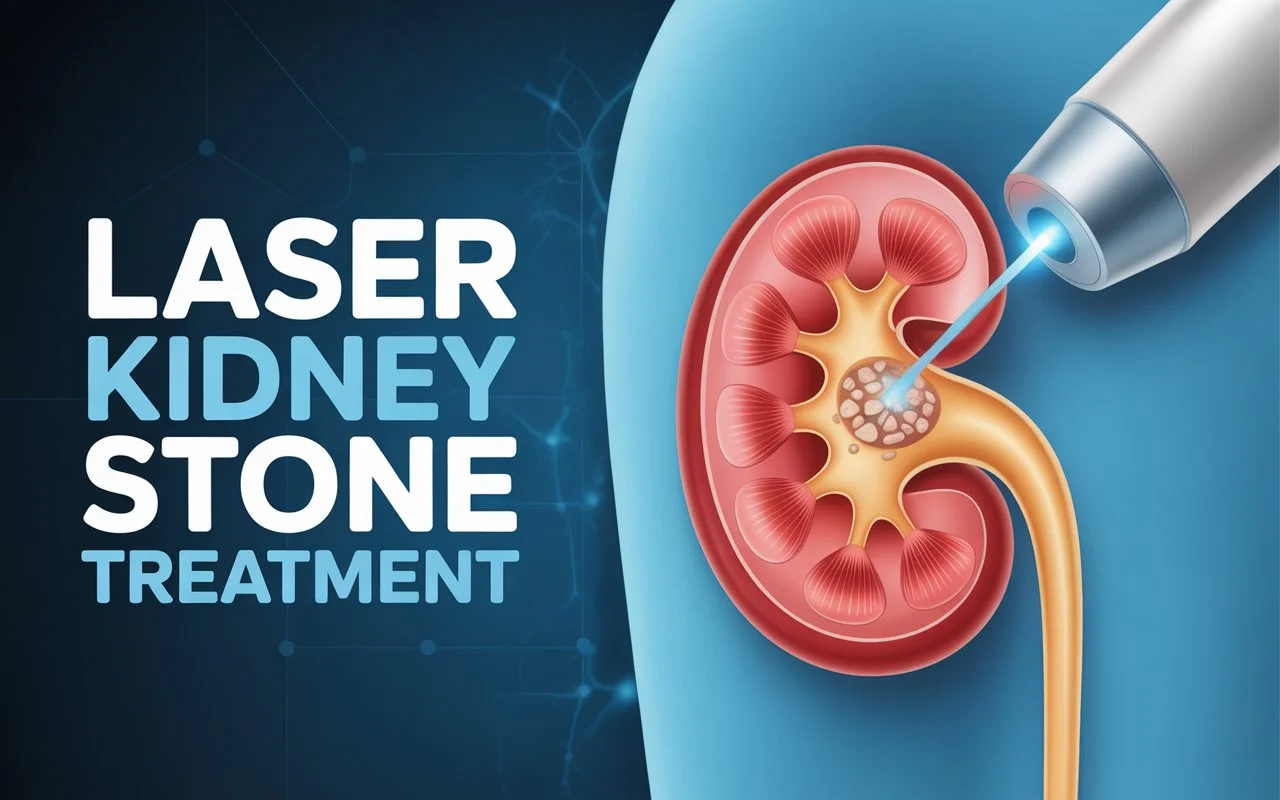
If you are scheduled for laser kidney stone surgery (ureteroscopy), you probably have two main questions: Will it work? And how bad is the recovery?
While standard medical brochures call this procedure "minimally invasive", they often gloss over the day-to-day reality of healing. This guide bridges that gap, offering a realistic roadmap from the moment you wake up to the moment you are back to your pain-free life.
What is Laser Kidney Stone Treatment?
Commonly known as laser lithotripsy, this modern procedure uses a tiny laser fibre to break stones into fragments. Because the doctor accesses the stone through the natural urinary pathway, there are no cuts, no stitches, and no scars.
Who is advised for this treatment?
Doctors typically recommend the laser approach if:
- Your stone is larger than 6–7 mm.
- The stone is stuck in the ureter.
- You are experiencing repeated infections or severe pain.
- Other treatments like shockwave therapy (ESWL) have failed.
The Procedure: Dusting vs. Fragmenting
In 2026, surgeons use advanced holmium or thulium fibre lasers to handle stones in two ways:
- Dusting: The laser turns the stone into a fine powder that you pee out effortlessly.
- Fragmenting: The laser breaks the stone into small pieces that the surgeon removes using a tiny "basket".
The Result: A much higher success rate in a single session compared to traditional methods.
The "Stent Survival Guide": Your Secret Weapon
Most patients agree: the surgery is easy; the ureteral stent is the challenge. This small, flexible tube is left inside to ensure your ureter doesn't swell shut.
To thrive (not just survive) with a stent, follow these rules:
- The "False Alarm": The stent tickles your bladder, making you feel like you need to pee every 5 minutes. This is normal. Don’t strain; just let it flow.
- Heat is key: Use a heating pad on your lower back or pelvis. This is often more effective for bladder spasms than medicine.
- Watch the Colour: Your urine will look like fruit punch or tea (haematuria). This is normal as long as it isn't thick like tomato soup or full of large clots.
- Avoid the "Stent Tug": If your stent has a string, do not pull it! Tape it securely to your leg so it doesn't catch on your clothes.
Recovery Timeline at a Glance
| Time Period | What to Expect | Your Goal |
| First 24 Hours | Grogginess, burning during urination, and pink urine. | Hydrate: 8–10 oz of water every hour. |
| Days 2–3 | Dull ache in the back (kidney area), stone dust passing. | Management: Take meds on a strict schedule. |
| Days 4–7 | Pain reduces, but the stent feels like a "nuisance". | Light Activity: Return to desk work. |
| 1–2 Weeks | Full recovery and stent removal. | Prevention: Start the "Never Again" plan. |
Practical "Can I...?”
- Can I drive? Usually 24–48 hours later, provided you are off all prescription pain narcotics.
- Can I exercise? Stick to walking. Running or heavy lifting can cause the stent to rub your bladder, leading to more blood in the urine.
- Can I fly? Yes, but stay hydrated and walk the aisle every hour to prevent blood clots.
- When can I have sex? It is best to wait until the stent is removed and any burning sensation has stopped.
The "Never Again" Plan: Preventing Recurrence
You don't want to go through this twice. Follow these three 2026-standard prevention tips:
- The Lemon Hack: Add fresh lemon juice to your water. The citrate helps prevent new crystals from forming.
- Dilution is the solution: Aim for 2.5 to 3 litres of water daily so your urine stays clear.
- Stone Analysis: Ensure your doctor analyses the fragments. Knowing if your stone was calcium oxalate or uric acid changes your diet plan completely.
Conclusion
Laser kidney stone treatment is a safe, highly effective, and patient-friendly solution. While the recovery, and the stent, can be uncomfortable for a few days, following a structured plan makes it manageable. You’ll be back to your routine before you know it, and more importantly, you’ll be pain-free.
If you have more questions about your upcoming surgery or recovery, click here to book a consultation with our stone specialist today.